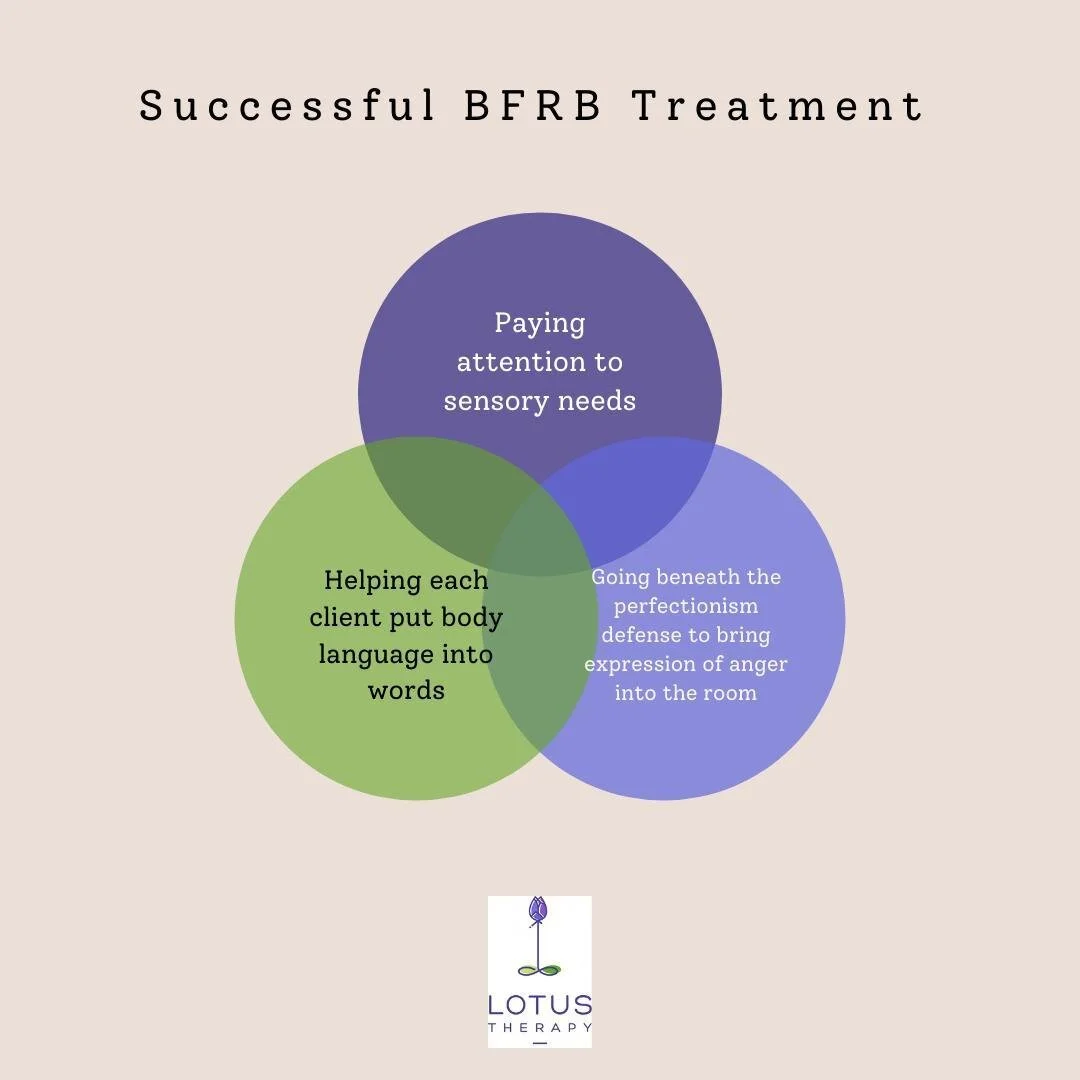
Three key components of successful BFRB treatment
Hello all! For those of you who haven’t seem my Instagram feed (@lotustherapyatx) I wanted to share a talk I gave recently about three key components of treatment for body-focused repetitive behaviors (BFRBs):
I’m here today because I led workshop for the American Group Psychotherapy Association (AGPA), and I figured that with so much on my mind about working therapeutically with hair-pullers and skin-pickers, I’d like to share a bit with you all.
I had a wonderful group at the conference, just a wonderful group of therapists so interested in this topic and they reminded me that there’s not much information out there about how to work with these populations, especially from a psychodynamic perspective. I incorporate cognitive and relational techniques, but the work is grounded within the therapeutic relationship, which is where I think the magic happens.
For today, I’m just going to go over one of the slides I used in my presentation that I think might be helpful to everyone, in terms of both if you are someone being treated for hair-pulling or skin-picking or you are a therapist working with this population. Of course these are very complex disorders and a complex treatment process, but I’ll try to break it down to the three key components of successful BFRB treatment.
The first key is attention to sensory needs. In counseling, people are going to have to do something with their hands if they are to learn to not always relate to their emotions by picking or pulling. So therapists should understand that it is important to be able to fiddle with something while you get in touch with your emotions.
Along with that, the second key component is that it is the therapist’s job to really help the client translate body language into words. So I notice, in my sessions, that often we will be talking about a topic of emotional stress, perhaps an argument with one’s partner, or maybe a phone call with a mom, and that’s when I’ll start to notice a person’s hand starts to go to their hair to search for something to pull or to their face to find something to pick.
So it is really important for therapists to help the client translate that motion into words. So I will often tell a client something like, “I noticed that your hand went to your hair just as you started talking about your mother, I wonder what feelings might have come up in that moment?” That way we begin to break down the impulsive and compulsive elements of these behaviors and begin to add some mindfulness and understanding to them. We see that there usually is a reason why the hands go to the hair or skin.
As I talked about in my workshop, I often use fiddle toys to help with this translation. In the case study I discussed, I mentioned a client who squeezed my toy caterpillar really hard in a group session, and another group member was able to ask her what she was so angry about and help her translate that angry motion into words.
The third key component is one that isn’t as well-understood as I think it should be, and that is, we need to work through the perfectionism defense of people who struggle with picking or pulling. Perfectionism is a theme that runs through all of the literature on this population, and yet, we haven’t really answered, what does that mean, and how can we work with it now that we know this fact?
What I have discovered is that this perfectionism is usually a coping strategy, when as a child someone finds that it works better in their families if they have less needs and less anger. That’s where perfectionism comes in. It’s a very tricky one, because it is a defense that is very popular. If you are pleasing and you keep your anger to yourself and you always do what people ask of you, you may well never be noticed, you might glide through, people think everything is OK but really, the picking or pulling is the one signal that something is not OK.
So I think some researchers have made that mistake, in that some early treatment results looked really good after behavioral treatment but were followed by many relapses. This may be because people who pick and pull are likely to try to please their therapist, and go along with the treatment protocols, while the deeper needs and feelings being expressed through the behaviors get lost behind that perfectionism and aren't addressed. And the main feeling being tucked away behind that perfect exterior is anger.
So, if we think about it that way, one of our key goals is to help people express their anger in words, and to get some of that frustrated energy out of their hands. So I would be interested to know what that brings up for people, I know that’s a stimulating idea, that anger is really a lot of what is in restless hands.
Nancy Keuthen and some other researchers did study this topic in 2016 and found that people who pick and pull do tend to internalize their angry feelings in particular more than others, and that the more intense the picking and pulling and its consequences, usually, the internalization and repression of anger is also more intense.
One thing we know about anger and keeping it in is that that aggressive energy needs to go somewhere! One way to think about picking and pulling is as a way to release some of that energy bit by bit and the more we can help people put their anger into words, the less they will need to rely on that behavior to get it out of their bodies.
For me, as a recovering skin-picker, I found a way to get the anger and frustrated energy out of my body through an amateur boxing career. That’s a bit on the extreme side, but really, anger is a physical emotion and it needs to come out of the body.
So just to wrap it up, the three key components of successful BFRB treatment are attention to sensory needs, helping each clients to put body language into words, and going beneath the perfectionism defense to bring the expression of anger into the room.
For those therapists out there, it can be very helpful to bring angry energy out toward yourself, because you have the opportunity to model making space for angry energy without being intimidated by it ourselves.
I’m ready to go home and release all of the stress and pressure of planning for this workshop, and it was nice to have the last hurrah with you all before I head home. Until next time!